
Best Software Companies? Expert Analysis of Industry Leaders and Market Trends
The software industry has fundamentally transformed how businesses operate, scale, and compete in the digital economy. Today’s most successful enterprises rely on sophisticated software solutions to streamline operations, enhance customer experiences, and drive innovation at scale. Understanding which software companies lead the market—and why—provides valuable insights for business leaders making critical technology investments.
The landscape of software companies spans multiple sectors: enterprise resource planning (ERP), customer relationship management, cloud infrastructure, cybersecurity, and specialized industry solutions. Each category presents distinct opportunities and challenges for organizations seeking to optimize their technological infrastructure. This comprehensive analysis examines the industry’s top performers, emerging trends, and strategic considerations for selecting software solutions that align with business objectives.
Market Leaders in Enterprise Software
The enterprise software sector represents the most mature and competitive segment of the software industry. Companies like Microsoft, Oracle, and SAP have dominated this space for decades by providing comprehensive solutions that address complex business challenges. Microsoft’s dominance extends across multiple domains—from Office productivity suites to Azure cloud services—making it arguably the most diversified software powerhouse globally.
Oracle maintains its leadership position through robust database solutions and enterprise applications that power mission-critical operations for Fortune 500 companies. The company’s strategic acquisitions of NetSuite and other cloud-native platforms demonstrate a commitment to modernizing its portfolio and competing effectively against newer, cloud-first competitors. SAP similarly leverages its extensive customer base and deep industry expertise to deliver integrated business solutions.
Beyond these established giants, companies like Salesforce have revolutionized how enterprises approach customer engagement and data management. Salesforce’s cloud-first architecture and emphasis on user experience have attracted organizations across industries seeking modern alternatives to legacy systems. The company’s continued expansion through strategic acquisitions reflects its ambition to become a comprehensive business cloud platform.
Key characteristics of successful enterprise software companies include:
- Robust scalability supporting organizations from mid-market to enterprise scale
- Comprehensive security frameworks protecting sensitive business data
- Extensive integration capabilities with existing business systems
- Dedicated customer support and professional services
- Continuous innovation addressing evolving market demands
Organizations evaluating enterprise software solutions should consider how these platforms integrate with their existing technology stack. The decision to implement enterprise software often represents a multi-year, significant financial commitment, making thorough due diligence essential. Understanding the total cost of ownership—including implementation, training, maintenance, and potential customization—ensures realistic budget planning.
Cloud Computing and Infrastructure Giants
Cloud infrastructure has emerged as the foundational technology reshaping enterprise computing. The advantages of cloud computing in business have driven massive growth in this sector, with Amazon Web Services (AWS), Microsoft Azure, and Google Cloud Platform establishing themselves as the dominant providers.
AWS maintains its market leadership through an unparalleled breadth of services—over 200 offerings covering compute, storage, databases, analytics, machine learning, and specialized solutions. The platform’s maturity, extensive documentation, and vast ecosystem of certified partners make it the preferred choice for organizations of all sizes. AWS’s pricing flexibility and pay-as-you-go model align well with modern business operations.
Microsoft Azure benefits from deep integration with Windows Server, Office 365, and enterprise applications, creating natural adoption pathways for organizations already invested in Microsoft’s ecosystem. Azure’s hybrid capabilities, allowing seamless integration between on-premises and cloud infrastructure, appeal particularly to enterprises managing legacy systems alongside cloud initiatives.
Google Cloud Platform, while smaller in market share, has gained significant traction among data-intensive organizations and startups valuing its advanced analytics, machine learning, and artificial intelligence capabilities. Google’s expertise in handling massive-scale data operations translates into competitive advantages for organizations requiring sophisticated data processing.

Critical factors when evaluating cloud providers include:
- Service breadth and depth: Assess whether the provider offers solutions matching your technical requirements
- Geographic presence: Evaluate data center locations ensuring compliance with regulatory requirements
- Cost structure: Compare pricing models and calculate total cost of ownership for anticipated usage patterns
- Security certifications: Verify compliance with industry standards (ISO 27001, SOC 2, HIPAA, etc.)
- Support offerings: Determine available support tiers and response time guarantees
- Migration assistance: Evaluate tools and services supporting transition from existing infrastructure
The shift toward cloud infrastructure represents a fundamental architectural change for many organizations. Rather than investing heavily in on-premises hardware and infrastructure, companies can leverage cloud providers’ economies of scale to access enterprise-grade computing resources flexibly and cost-effectively.
Customer Relationship Management Excellence
Customer relationship management software has become essential for organizations prioritizing customer experience and data-driven decision-making. Salesforce dominates this category, but competitors like HubSpot, Microsoft Dynamics 365, and SAP C/4HANA offer compelling alternatives targeting different market segments and organizational needs.
Salesforce’s comprehensive platform encompasses sales automation, customer service, marketing automation, and commerce solutions. The platform’s extensive AppExchange marketplace provides thousands of third-party integrations and extensions, allowing organizations to customize solutions matching specific business processes. For many organizations, exploring best CRM software for small business options reveals that Salesforce remains a leading choice despite newer competitors challenging its dominance.
HubSpot has successfully positioned itself as a more accessible alternative to Salesforce, particularly for small and mid-market organizations. HubSpot’s freemium model, user-friendly interface, and integrated approach combining CRM, marketing automation, and customer service appeal to organizations seeking simpler, more affordable solutions. The platform’s emphasis on inbound methodology resonates with modern marketing practices.
Microsoft Dynamics 365 leverages integration with Microsoft’s broader ecosystem, including Office 365, Power BI, and Azure. Organizations already invested in Microsoft technologies often find Dynamics 365 attractive due to seamless integration and unified licensing opportunities. The platform’s flexibility in deployment models—cloud, on-premises, or hybrid—accommodates diverse organizational preferences.
SAP C/4HANA represents SAP’s cloud-native CRM solution, designed for large enterprises managing complex customer relationships across multiple geographies and business units. The platform’s advanced analytics and real-time processing capabilities support sophisticated customer insights and personalization initiatives.
Essential CRM capabilities include:
- Contact and account management with comprehensive customer profiles
- Sales pipeline visibility and opportunity tracking
- Automated workflows reducing manual data entry and administrative burden
- Reporting and analytics providing actionable customer insights
- Mobile accessibility enabling field teams to access critical information
- Integration capabilities connecting with marketing, service, and accounting systems
Emerging Technologies and Innovation
Artificial intelligence and machine learning are reshaping software capabilities across all categories. Leading software companies are embedding AI-powered features enabling predictive analytics, intelligent automation, and enhanced decision-making. Salesforce’s Einstein AI, Microsoft’s Copilot, and similar offerings represent the industry’s evolution toward AI-augmented software.
Cybersecurity software has become increasingly critical as organizations face escalating threats. Companies like CrowdStrike, Palo Alto Networks, and Fortinet lead the market in providing advanced threat protection, endpoint security, and security orchestration solutions. The integration of AI and machine learning into security platforms enables faster threat detection and response.
Low-code and no-code platforms are democratizing software development, allowing business users without extensive programming expertise to build applications addressing specific business needs. Platforms like OutSystems, Mendix, and Microsoft Power Apps enable rapid application development while reducing dependency on scarce software engineering talent.
Data analytics and business intelligence platforms continue evolving to support organizations’ growing data volumes and complexity. Tableau, Looker, and Microsoft Power BI compete intensely in this space, offering increasingly sophisticated visualization and analytical capabilities. Organizations implementing these tools gain competitive advantages through data-driven decision-making.
Selecting the Right Software Partner
Choosing software solutions represents one of the most consequential decisions technology leaders make. The selection process should balance functional requirements, technical architecture, cost considerations, and strategic alignment with organizational objectives.
When developing selection criteria, organizations should conduct thorough needs assessments identifying current pain points and future requirements. Engaging stakeholders across departments—finance, operations, customer service, marketing—ensures the selected solution addresses enterprise-wide needs rather than optimizing for a single function.
Implementing business risk management framework principles during software selection helps identify potential implementation risks and develop mitigation strategies. Common risks include scope creep, inadequate change management, insufficient training, and unrealistic timelines.
Total cost of ownership analysis should extend beyond software licensing to encompass implementation services, customization, training, ongoing support, and maintenance. Many organizations underestimate these indirect costs, which frequently exceed initial software licensing expenses. Requesting detailed cost proposals from vendors ensures transparency and accurate budget planning.
Reference checks and pilot implementations provide valuable validation before committing to enterprise-wide deployments. Speaking with existing customers using the software under similar circumstances reveals practical insights about implementation experiences, support quality, and actual value realization. Pilot implementations allow teams to evaluate functionality in their specific environment and identify customization needs.
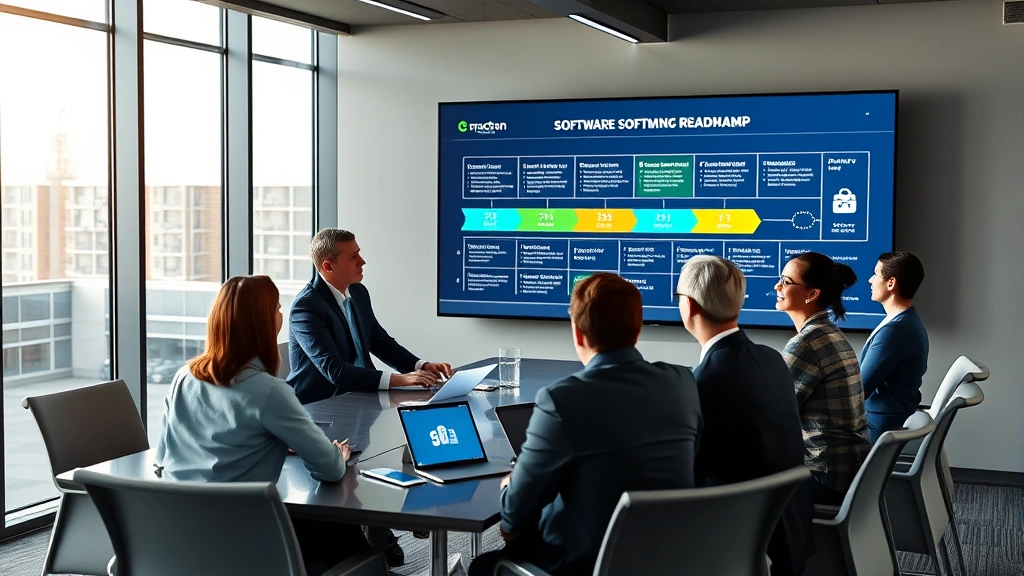
When developing an elevator pitch for software initiatives to executive leadership, emphasize how solutions address specific business problems, generate measurable value, and align with strategic priorities. Quantifying expected benefits—revenue growth, cost reduction, efficiency improvements—strengthens business cases and facilitates approval processes.
Future Trends Shaping the Industry
The software industry continues evolving rapidly, shaped by technological advances, changing business requirements, and competitive pressures. Understanding emerging trends helps organizations make forward-looking technology investments.
Key trends influencing software development include:
- Composable architecture: Organizations increasingly adopt modular, API-first approaches enabling flexible combinations of best-of-breed solutions rather than monolithic platforms
- Sustainability focus: Software companies emphasize energy efficiency and carbon footprint reduction, responding to organizational sustainability commitments
- Edge computing: Processing data closer to sources rather than centralizing in cloud data centers reduces latency and bandwidth requirements for specific applications
- Quantum computing: Early-stage quantum computing capabilities will eventually transform cryptography, optimization, and simulation applications
- Extended reality: Augmented and virtual reality technologies are increasingly integrated into enterprise applications for training, design, and customer engagement
- API economy: Organizations leverage APIs to create ecosystems of interconnected services, driving innovation and new business models
When creating a product roadmap for software initiatives, incorporate emerging technologies that provide competitive advantages while maintaining realistic implementation timelines. Balancing innovation with stability ensures organizations leverage new capabilities without introducing excessive technical risk.
The evolution toward event-driven architecture enables real-time responsiveness to business conditions. Organizations implementing event-driven systems can react immediately to customer actions, market changes, and operational anomalies, creating competitive advantages in fast-moving industries.
Remote work’s permanence has accelerated demand for collaboration software, cybersecurity solutions, and unified communication platforms. Companies like Slack, Microsoft Teams, and Zoom have experienced explosive growth as organizations recognize remote work’s durability and seek tools optimizing distributed team productivity.
Sustainability considerations increasingly influence software vendor selection. Organizations committed to environmental responsibility evaluate vendors’ energy consumption, carbon offsets, and commitment to sustainable practices. Leading software companies are responding by publishing sustainability reports and implementing green technology initiatives.
FAQ
What software company is the largest globally?
Microsoft is widely considered the world’s largest software company by market capitalization and revenue, with dominant positions in operating systems, productivity software, cloud infrastructure, and enterprise applications. However, Apple, Alphabet (Google), and Amazon also represent massive software-driven technology companies with comparable valuations and influence.
How do I evaluate software companies for investment purposes?
Evaluate software companies by analyzing revenue growth rates, profit margins, customer acquisition costs, customer lifetime value, market share trends, competitive positioning, management quality, and strategic vision. Research analyst reports from firms like Gartner and McKinsey provide valuable market perspectives. Consider the company’s ability to adapt to technological changes and maintain customer satisfaction.
What are the main differences between SaaS and traditional software?
Software-as-a-Service (SaaS) applications run on vendor-managed cloud infrastructure, accessed through web browsers, with automatic updates and scalable pricing. Traditional software requires on-premises installation, local maintenance, manual updates, and typically involves perpetual licensing. SaaS offers greater flexibility, lower upfront costs, and easier scalability, while traditional software provides more control and potentially lower long-term costs for stable, long-term deployments.
How important is vendor reputation when selecting software solutions?
Vendor reputation significantly influences software selection decisions. Established vendors typically offer better stability, support quality, security practices, and long-term viability. However, emerging companies sometimes provide innovative solutions addressing specific needs better than established players. Balance vendor reputation with functional fit, ensuring the selected solution addresses your organization’s actual requirements regardless of vendor size.
What security considerations should influence software selection?
Prioritize vendors demonstrating strong security practices including regular security audits, penetration testing, vulnerability disclosure programs, encryption standards, access controls, and compliance certifications (ISO 27001, SOC 2, HIPAA). Evaluate data residency options ensuring compliance with regulatory requirements. Request security documentation and conduct due diligence before signing agreements. Security should never be compromised for functionality or cost.
How can organizations minimize software implementation risks?
Minimize implementation risks through thorough planning, realistic timelines, adequate training, strong change management, clear success metrics, executive sponsorship, and experienced implementation partners. Start with pilot implementations in limited departments before enterprise-wide rollouts. Maintain realistic scope, avoiding feature creep that extends timelines and increases costs. Establish clear governance structures ensuring accountability and decision-making authority throughout implementation.
Which software companies are best for small businesses?
Small businesses benefit from user-friendly, affordable solutions including HubSpot for CRM, QuickBooks for accounting, Shopify for e-commerce, Canva for design, and Slack for communication. These companies offer scalable pricing, minimal implementation requirements, and intuitive interfaces suitable for teams with limited technical resources. Many provide free or low-cost plans allowing small businesses to evaluate functionality before financial commitment.


